

Hanukkah
Nightly Celebration
Night 1, Dec. 24: One God, One Temple
The Jewish God and the Jewish temple were somewhat of anomalies in the ancient Mediterranean world. Among Israel's polytheistic neighbors, multiple deities were worshipped at multiple cultic sites. In contrast, the Jewish people worshipped only one God, at one Temple located in Jerusalem. This Temple was the center of Jewish religious life and worship at the Temple was the primary means of honoring the God of Israel.
Night 2, Dec. 25: Two Worldviews: Torah vs. Hellenism
In 331 BC, Alexander the Great decisively defeated the Persian armies and exerted control over the Middle East (ancient Near East). Alexander brought with him a new Greek-inspired worldview - Hellenism - that directly conflicted with the traditional Torah-centered worldview of the Jewish people. This conflict would create simmering unrest both between Jews and their Hellenistic overlords, as well as between Jews who remained committed to Torah and Jews who became Hellenized.
Night 3, Dec. 26: Three Factions
After Alexander the Great's death, his empire split into multiple, competing factions. Two of these factions - the Egyptian Ptolemies and the Syrian Seleucids - fought over the territory of Judea. A third faction - a limited Jewish government run by priestly leadership - found itself caught in the middle of this conflict.
Night 4, Dec. 27: Antiochus IV (Epiphanes)
The Seleucids eventually defeated the Ptolemies and gained control of Judea. Their ruler - Antiochus IV - wanted to strengthen his control over the region and so he instituted harsh and oppressive policies for the Jewish population. His strategy - to thoroughly Hellenize the Jews - was carried out by (a) outlawing Jewish religious rites and traditions, and (b) ordering mandatory participation in Hellenistic religious customs.
Night 5, Dec. 28: Five Sons of Mattathias
An elderly priest from a small town called Modi'in refused to follow the oppressive decrees of Antiochus IV. At a town gathering, Seleucid officials attempted to force the local Jewish population to conduct pagan sacrifice. Mattathias killed a Jewish collaborator and fled to the wilderness with his five sons. Although Mattathias died within a year, his sons took up the cause and led a rebellion against the Seleucid empire. Of his five sons, Judah, Jonathan, and Simon were the most influential.
Night 6, Dec. 29: 166 BC The Battle of Emmaus
Using guerilla tactics, Judah and his troops fought their way to a series of early victories. A turning point in the rebellion was the Battle of Emmaus in 166 BC - a decisive victory for the Jewish troops that forced the Seleucid forces to retreat and regroup. This opened the way for Judah's army to retake Jerusalem. After a period of hard fighting, Judah and his troops managed to capture most of the city and reclaim possession of the Temple.
Night 7, Dec. 30: Seven Branches of the Temple Menorah
Having reclaimed the Temple, the Jewish rebels set about rededicating the Temple and reinstituting proper worship. One key obstacle stood in their way: they were only able to find one container of olive oil to fill the seven oil lamps of the Temple menorah. Under normal circumstances, one container would only be enough to fuel the Menorah for one day.
Night 8, Dec. 31: Eight Miraculous Days
According to the Talmud (Shabbat 21b), the oil that should have only lasted for one day ended up fueling the Menorah for eight days - the amount of time needed for the priests to press and prepare additional olive oil. To commemorate this miracle, Jewish communities around the world celebrate the festival of Hanukkah - which is the Hebrew word for "Dedication" - every year, starting on the 25th of the month of Kislev, which the day on which Judah and his troops rededicated the temple. Using special eight-branched menorahs, Jewish families light one candle each night for eight nights, to commemorate the eight days of the original miracle.
Thanks for celebrating with us!
History
The Victory
At its heart, Hanukkah (or Chanukah) is a great story of victory for the Jewish people. It is an annual festival held in the third month of the Jewish calendar, beginning on the 25th day of Kislev and continuing for eight nights. It is also known as the Festival of Lights, the Feast of Dedication, and the Feast of the Maccabees.
Early in the second century BC, after Antiochus Epiphanes had taken control of the Seleucid Empire, he began persecuting and executing the Jewish people. The religion of Judaism was banned, and the Temple in Jerusalem was desecrated.
In 165 BC, after years of persecution, execution, and desecration, Mattathias the high priest, and his son, Judah, took control of the underground Israelite rebel forces. Mattathias led Israel in a slow-but-sure uprising during the next three years that eventually defeated Antiochus and the rest of the Seleucids. Against all odds, and with minimal weaponry, the result was an overwhelming victory for the Jewish people. Because of this military success, Mattathias became known as “Mattathias HaMaccabee” (Mattathias the Hammer).
The Israelites had reclaimed Jerusalem and retook the Temple; they cleansed it immediately, and rededicated it to the Lord.
The Miracle
After reclaiming the Temple, the priests looked high and low for usable oil to keep the menorah lamps lit to complete the cleansing. They only found only one jug—enough for a day—that would do the job. But instead of lasting one day, this miracle oil lasted eight! During these eight full days, the Jews were able to make new oil, thus never having to be without light. The Festival of Hanukkah commemorates Israel’s victory, and celebrates the miracle of the oil— which is why this holiday is eight days (and nights) long.
Traditions
The Menorah
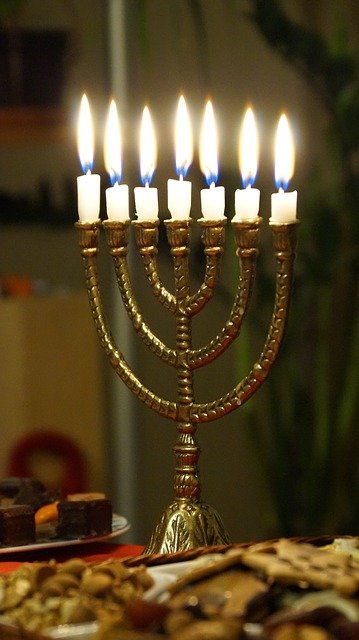
Hanukkah’s most recognized tradition is the lighting of the menorah. Over the course of eight days, Jewish families light a modified menorah—called a hanukkiah, which has eight branches (instead of the usual six) to symbolize the eight days of the original miracle. A blessing is recited each night as these special candles are lit.
The Food
Hanukkah’s festivities, like any good celebration, include lots of good food and music. The mainstay of this holiday is the traditional latke, best described as a potato pancake. Also included are doughnuts, and other various fried foods, to commemorate the miracle of the oil.
For different delectable Hanukkah recipes, visit these links:
http://hanukkah.123holiday.net/hanukkah_recipes.html
http://allrecipes.com/recipes/holidays-and-events/hanukkah/Top.aspx
http://www.epicurious.com/recipesmenus/holidays/hanukkah/recipes
The Music
And what would a celebration be without music? The links below list some of the more common and traditional Hanukkah songs, with lyrics translated in English, Yiddish, and Hebrew.
http://hanukkah.123holiday.net/hanukkah_songs.html
http://judaism.about.com/od/holidays/a/Hanukkah-Songs-Lyrics.htm
The Gifts
Gifts were originally not part of Hanukkah. In the beginning, gelt—money or chocolate coins covered in gold tin foil—were given to children as rewards (they are often tested in how well they know the story of Hanukkah). However, given that Hanukkah is celebrated around the same time of year as Christmas, Jewish children who saw Christian children receiving gifts became jealous. To appease their children, some Jewish parents eventually evolved the gelt-giving into gift-giving.
http://www.jewfaq.org/holiday7.htm#Tradition
The Blessings
There are three brachos, or blessings, recited when the Hanukkah candles are lit.
"Baruch ata Ado-nai, Elo-heinu Melech ha'olam, Asher kid'shanu b'mitzvosav v'tzivanu l'hadlik ner shel Chanukah"
Blessed are You, Hashem our G-d, King of the universe, Who has sanctified us with His commandments, and has commanded us to Kindle the Chanukah light.
"Baruch ata Ado-nai, Elo-heinu Melech ha'olam, She'asah nisim la'avoseinu, bayamim ha'hem baz'man hazeh"
Blessed are You, Hashem our G-d, King of the universe, Who has wrought miracles for our forefathers, in those days at this season.
"Baruch ata Ado-nai, Elo-heinu Melech ha'olam, She'hecheyanu, vekiyemanu vehigi'anu laz'man hazeh" (Recited on the first night only)
Blessed are You, Hashem our G-d, King of the universe, Who has kept us alive, sustained us, and brought us to this season.
After these blessings are said, the following paragraph is to be recited, as well as the song is to be sung.
"Ha'Neiros halalu anachnu madlikin al hanisim ve'al hanifla'os, ve'al hat'shu'os ve'al hamilchamos, sh'asisa la'avoseinu bayamim hahem baz'man hazeh, al yedei kohaneicha hakedoshim. Vechol sh'monas yemei Chanukah, haneiros halalu kodesh hem. Ve'ein lanu reshus le'hishtamesh ba'hem, eh'la lir'osam bilvad, ke'dei le'hodos u'lehalel leshimcha hagadol al nisecha ve'al nifle'osecha ve'al yeshu'oshecha."
These lights we kindle upon the miracles, the wonders, the salvations, and the battles which you performed for our forefathers in those days at this season through Your holy priests. During all eight days of Chanukah these lights are sacred, and we are not permitted to make ordinary use of them, but to look at them in order to express thanks and praise to Your great Name for Your miracles, Your wonders and Your salvations.
O mighty Rock of my salvation,
http://hanukkah.123holiday.net/hanukkah_blessings.html
Games
The Dreidel
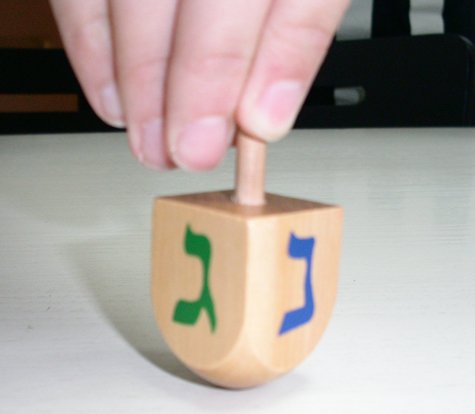
Perhaps the most well known Hanukkah amusement is the children’s game of dreidel. This little spinning top is four-sided, with a Hebrew letter on each side. The child spins the top and places a bet on which Hebrew letter will be showing when it lands. Children usually play for a pot of gelt (or chocolate coins covered in gold-colored tin foil).
Visit the link below for more on this fun pastime.
http://judaism.about.com/od/holidays/a/dreidel.htm